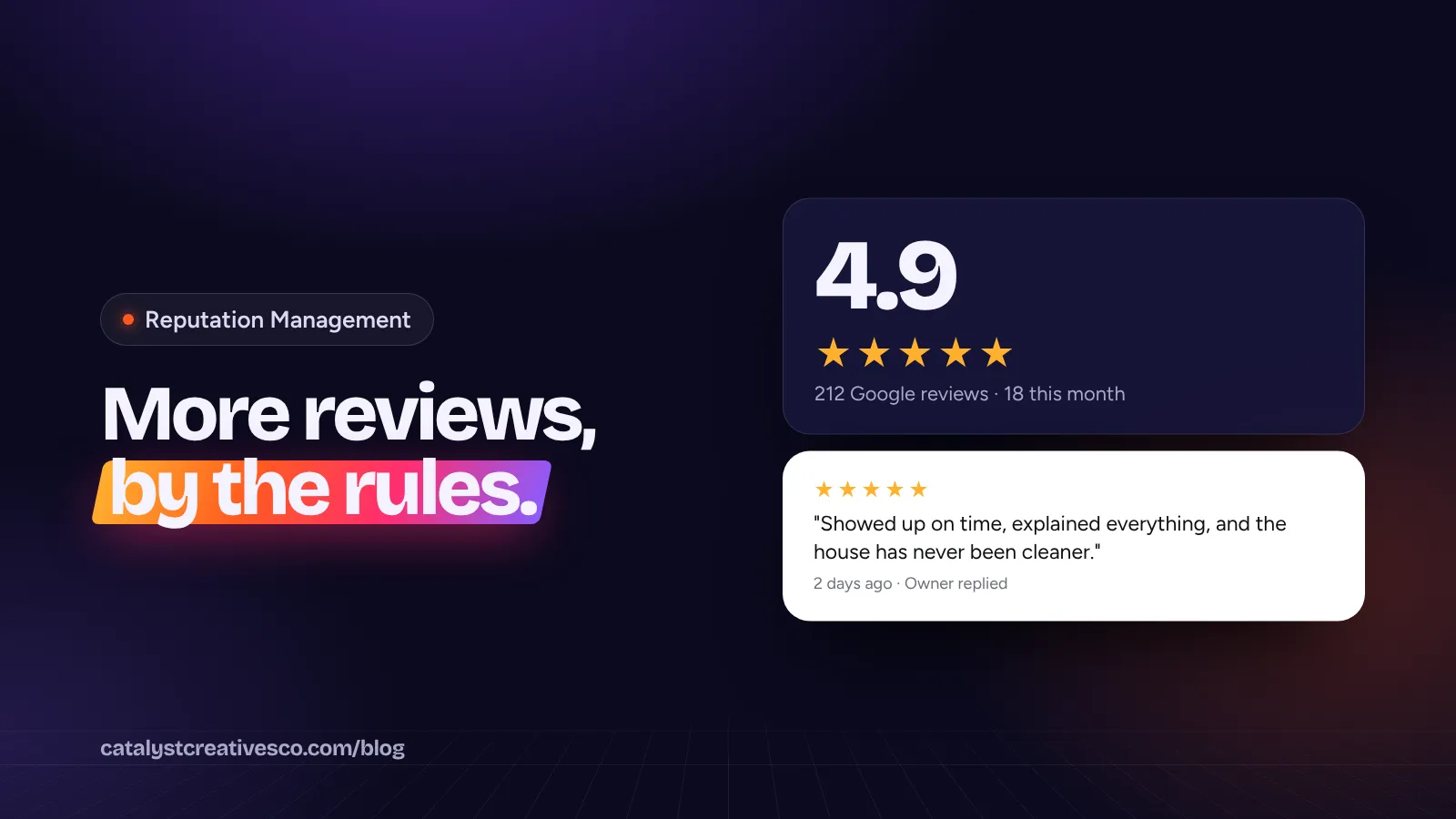
Reviews do two jobs for a local service business. They help you show up on Google, and they help people decide to call you once they find you. Most owners know they need more. Fewer know where the line is between asking well and breaking the rules, and since 2024 that line has had real fines attached.
Here's how to get a steady flow of honest Google reviews, without risking your profile or a penalty.
Why reviews matter more than ever
BrightLocal's 2026 survey of more than 1,000 US consumers found that 97% read reviews for local businesses. The bar is also getting higher:
- 68% will only use a business rated four stars or more, and 31% want 4.5 or higher.
- 47% won't use a business with fewer than 20 reviews.
- 74% only pay attention to reviews from the last three months.
That last one is the important one. A pile of old reviews isn't enough. You need new ones, every month. Google agrees: its own help page says more reviews and positive ratings can help your business's local ranking.
The rules, in plain English
Two sets of rules apply: Google's and the federal government's.
Google's rules
Google's policy for reviews on Maps says businesses must not:
- Offer incentives such as payment, discounts or free services in exchange for reviews.
- Discourage or prohibit negative reviews, or selectively ask only happy customers for reviews.
- Pressure customers to leave reviews while they're on your premises.
- Ask staff to collect a set number of reviews, or reviews that say specific things.
Reviews from employees, family or anyone with a conflict of interest aren't allowed either. Google removes reviews that break these rules, and can restrict or suspend profiles that keep doing it.
The FTC's rule
In August 2024 the Federal Trade Commission finalized a rule banning fake reviews and testimonials, which took effect on October 21, 2024. Among other things, it bans:
- Writing, buying or selling fake reviews, including ones written by AI.
- Offering anything in exchange for a review that's conditioned on it being positive (or negative).
- Reviews by owners, managers or staff without clearly disclosing the connection.
- Scaring people out of posting negative reviews with threats or false accusations.
The big change is that the FTC can now seek civil penalties for each violation. Every fake review could count separately.
What this means for you
The safe approach is simple: ask every customer, the same way, for an honest review, and give nothing in return. No "leave a five-star review and get 10% off". No sending happy customers to Google and unhappy ones to a private feedback form (that's called review gating, and Google's policy specifically rules it out).
How to get more reviews, the right way
1. Ask at the right moment
The best time is right after the job is done and the customer is happy: the carpet is dry, the kitchen is finished, the first visit went well. Ask in person, then follow up with a text the same day, while the job is still fresh in their mind.
2. Make it one tap
Every extra step loses people. In your Google Business Profile, use the "Ask for reviews" option to get a short link that opens the review box directly. Put it in your text message, your invoice email and your job completion email.
3. Ask everyone, automatically
The businesses with the most reviews don't rely on memory. They send a review request after every completed job, automatically, from their job software or CRM. That also keeps you on the right side of the rules, because everyone gets the same request.
4. Send one reminder
Plenty of people mean to leave a review and forget. One polite reminder a few days later is fine. More than that becomes pressure.
5. Help them say something useful
You can't tell customers what to write. You can make it easier to write something: "It helps other homeowners if you mention what we did for you." Reviews that mention the service and the town also give Google more to work with.
6. Reply to every review
In the same BrightLocal survey, 80% of consumers said they're more likely to use a business that responds to all of its reviews. Half are put off by copy-and-paste replies, so make each one personal. For a negative review, stay calm, apologize for the experience, and offer a way to sort it out. Future customers read your reply as much as the complaint.
What about bad reviews?
Every business gets them. A few negative reviews among lots of good ones make the profile look real. If a review breaks Google's rules (it's fake, from a competitor, or off-topic), you can report it from your profile. If it's an honest complaint, reply well and learn from it. Don't threaten legal action over an honest review. Under the FTC rule, that's exactly the kind of thing that can get a business in trouble.
A simple weekly routine
- Every completed job gets a review request, sent automatically.
- Every new review gets a personal reply within a few days.
- Once a week, check how many requests went out and how many reviews came in.
That's it. Steady beats clever. A business that adds a few honest reviews every week will pass a competitor who did one big push two years ago. Reviews also feed straight into your Google Business Profile, which is where most local calls start.
Want it running on autopilot?
Our free Growth Needs Assessment shows how your reviews compare with the top businesses in your area. Our reputation management service sets up automatic, rule-friendly review requests after every job, and helps you reply to every review.