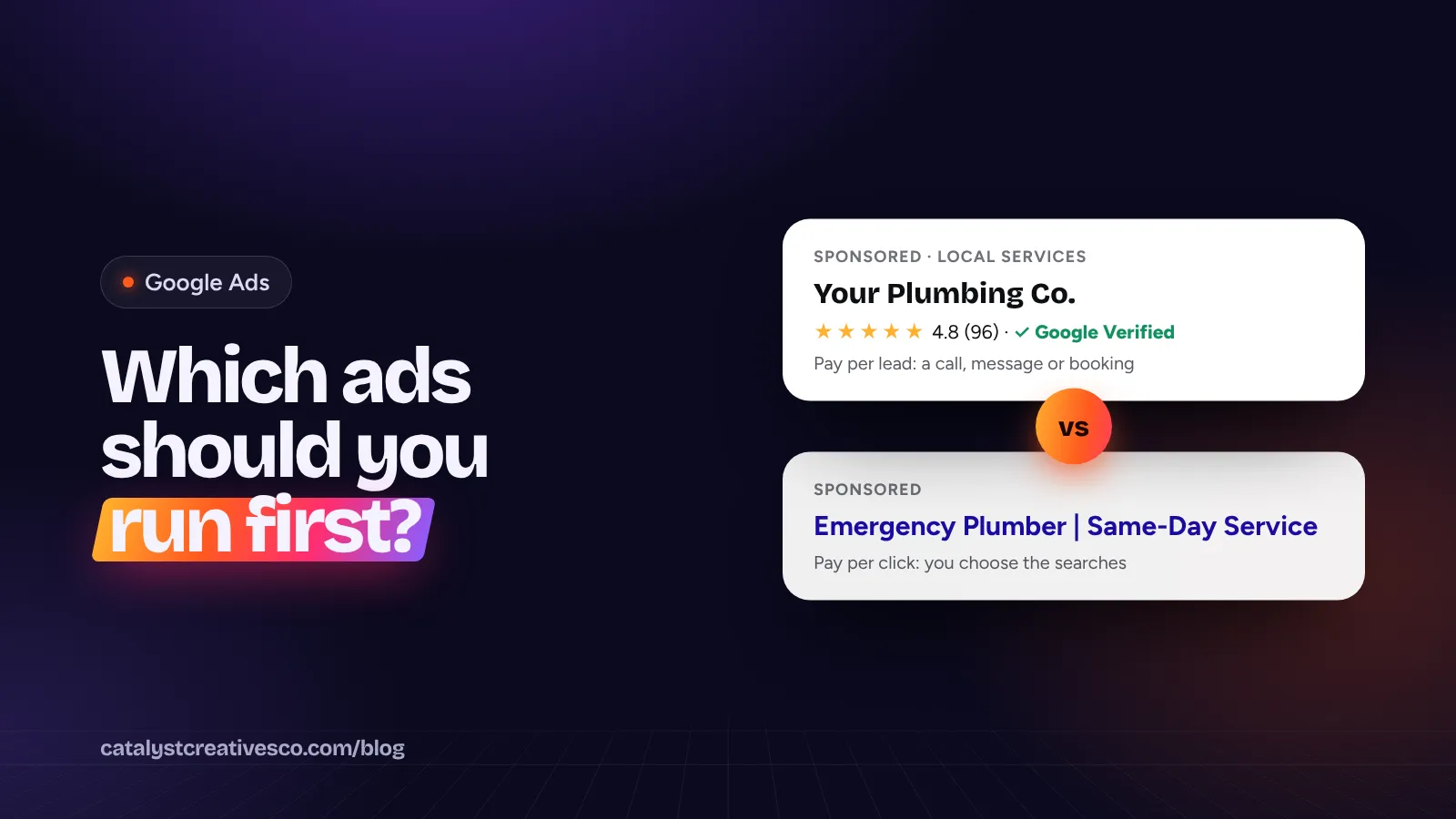
If you search for a plumber, a pest control company or a house cleaner on Google, you'll usually see two kinds of ads above the free results. One shows a business name, star rating and a "Google Verified" check. The other looks like a normal search result with a small "Sponsored" label. They work very differently, and picking the wrong one first is an expensive way to learn.
Here's how each one works, and how we decide which a business should start with.
Local Services Ads: you pay for leads, not clicks
Local Services Ads (LSAs) are the ads with the business name, reviews and the verified check. You don't write the ad. Google builds it from your profile, your reviews and the job types you pick.
The big difference is how you pay. Google says you only pay when a customer gets in touch from your ad: a call, a message or a booking. You don't pay for someone clicking around and leaving.
To get the check mark, your business has to pass Google's screening. In October 2025 Google replaced the old Google Guaranteed and Google Screened badges with a single "Google Verified" badge, and dropped the money-back guarantee that came with the old one. Depending on your trade and state, the checks can cover your business license, insurance and background checks.
Where LSAs shine
- Urgent jobs. Water damage, a burst pipe, a wasp nest by the front door. People call fast, and the LSA box is the first thing they see.
- Businesses with strong reviews. Your rating and review count sit right in the ad. Good reviews win more of the calls.
- Owners who don't want to manage keywords. There are no keywords to pick and no ad text to write.
Where LSAs fall short
- Less control. You pick job types and areas, but you can't choose the exact searches you show up for.
- Not every lead is a good one. Some calls will be for jobs you don't do or areas you don't serve. Google gives credits for some invalid leads, but you should check every lead and rate it.
- The system is changing. Google has started moving Local Services Ads into the main Google Ads platform, in stages from August 2026 through 2027. You'll still pay per lead, but bidding and reporting work differently, so export your old reports before your account moves.
Google Search Ads: you pay per click, with full control
Search ads are the text ads that look like search results. You choose the searches you want to show up for, write the ad, and send people to a page on your website. You pay each time someone clicks.
Where Search Ads shine
- Specific, high-value jobs. If you want kitchen remodels and not small repairs, or termite work and not one-off ant sprays, you can target exactly those searches and block the rest.
- Trades LSAs don't cover well. Not every service or region has Local Services Ads. Search ads work almost everywhere.
- Testing offers and pages. You can try different headlines and landing pages, and see which one books more jobs.
Where Search Ads fall short
- You pay for clicks that don't call. If your landing page is slow or confusing, you pay for visitors who leave.
- They need managing. Without weekly checks on search terms, budgets drift into searches like "how to fix a leak myself" or "cleaning jobs near me".
- Default settings work against you. For example, Google's location setting can show your ads to people who are only interested in your area, not just people in it. For a local trade, you almost always want people who are actually there.
So which one first?
Here's the simple version we use on assessment calls:
- Start with Local Services Ads if your jobs are urgent, you have at least a decent number of good reviews, your trade is covered, and someone can answer the phone quickly. That last part matters. LSA leads are calls, and a missed call is money gone. Since October 1, 2026, Google charges for missed calls during business hours when the caller stays on the line for more than 20 seconds. You can now pay for a lead you never spoke to.
- Start with Search Ads if you want to target specific high-value jobs, your reviews are still thin, your trade isn't covered by LSAs, or you have a strong landing page ready.
- Run both if you have the budget and you're tracking calls properly. They show in different places, and many businesses get their best results from LSAs for urgent work and Search Ads for planned, higher-value jobs.
The part most businesses skip
Whichever you choose, the ad is only half of it. The other half is what happens when someone calls. Invoca's 2026 home services benchmark, built on more than 70 million tracked calls, found that only 52% of callers to home services businesses spoke with a person, and that 55% of businesses didn't ask the caller to book the job.
Before you spend more on ads, make sure every call gets answered and every caller gets asked to book. That's often the cheapest increase in booked jobs you'll ever find. If you can't always get to the phone, read what happens to the calls you miss.
Want help picking?
Our free Growth Needs Assessment looks at your trade, your area, your reviews and your call handling, then tells you which ads make sense to start with. When you're ready, our Google Ads service sets up and runs both Local Services Ads and Search Ads, and tracks every call back to where it came from.